

CLINICAL CASE 03 OF 04 · PROVIDER EDUCATION
Dennis K.
Pulmonary Nodules After Solid-Organ Transplant
Veteran · Bilateral lung transplant recipient
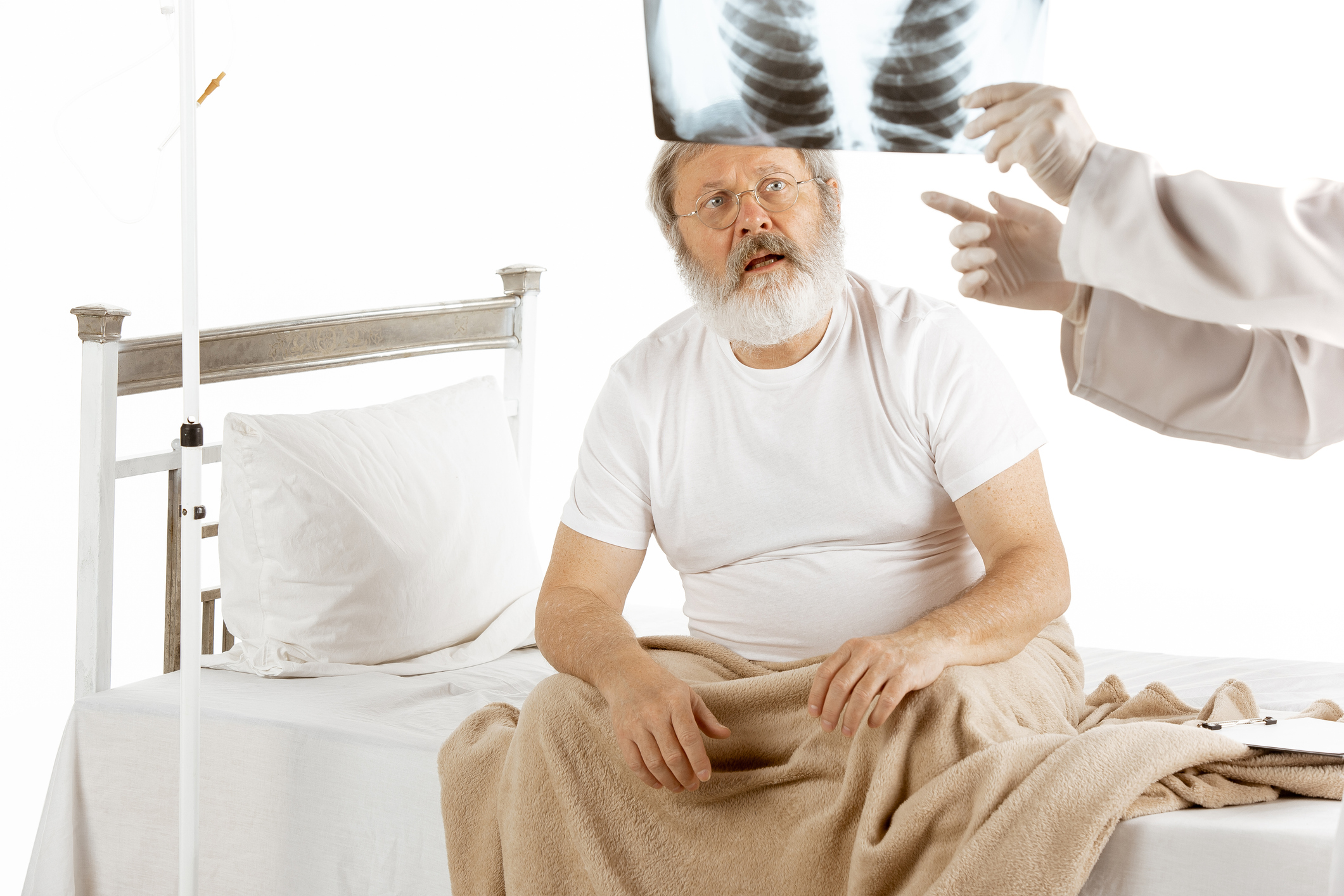
Fictional composite clinical scenario. The case and laboratory values are designed for professional education and do not describe a real veteran. Review the information at each decision point, select an answer in your mind, then open the explanation before continuing. No login or progress tracking is required.
CASE PRESENTATION
Pulmonary nodules amid transplant immunosuppression
Dennis underwent bilateral lung transplantation for fibrotic lung disease seven months ago. He receives tacrolimus, mycophenolate, and prednisone and recently completed a course of high-dose corticosteroids for acute cellular rejection. He now develops persistent fever, dry cough, pleuritic chest pain, and increasing dyspnea despite broad-spectrum antibacterial therapy. High-resolution chest CT demonstrates multiple nodular pulmonary opacities, some with surrounding ground-glass attenuation.
Laboratory and diagnostic data
| Test | Result | Interpretation |
|---|---|---|
| WBC | 3.1 × 10⁹/L | Leukopenia; reflects immunosuppression but is not diagnostic |
| Absolute neutrophil count | 1.8 × 10⁹/L | Not profoundly neutropenic; SOT risk does not require profound neutropenia |
| Creatinine | 1.6 mg/dL | Important baseline when selecting and monitoring antifungal therapy |
| Tacrolimus trough | 9.8 ng/mL | Relevant because major azole–calcineurin inhibitor interactions require close monitoring |
Fictional, clinically plausible educational values; use local reference ranges and assay cutoffs in practice.
CLINICAL DECISION 1 OF 3
Which interpretation best fits the CT findings in this host?
Reveal answer and clinical rationale
C. In a solid-organ transplant recipient receiving substantial immunosuppression, pulmonary nodules with surrounding ground-glass attenuation should raise concern for an invasive pulmonary mold infection such as invasive aspergillosis. The imaging pattern is not specific enough to establish the diagnosis, but the combination of compatible CT abnormalities, recent intensified corticosteroid exposure, and ongoing transplant immunosuppression creates a high-risk clinical syndrome that should trigger prompt fungal diagnostic evaluation.
Why the other options do not fit
CT findings alone do not prove invasive aspergillosis or identify the fungal species. The abnormalities do not exclude fungal disease. Pulmonary embolism can cause pleuritic symptoms, but this CT pattern in an immunosuppressed transplant recipient should prompt evaluation for invasive mold disease rather than being considered diagnostic of embolism.
References: 6, 8.
CASE CONTINUED
Because an invasive mold infection is now a concern, the team orders Aspergillus-directed testing and arranges bronchoscopy with bronchoalveolar lavage (BAL). When respiratory status permits, BAL is sent for fungal microscopy and culture, galactomannan, and additional molecular testing where validated and available. Serum galactomannan is also obtained, recognizing that its sensitivity may be lower in solid-organ transplant recipients than in some hematologic populations.
CLINICAL DECISION 2 OF 3
Why combine multiple diagnostic approaches?
Reveal answer and clinical rationale
A. The diagnosis of invasive aspergillosis is strongest when host risk factors, compatible clinical and radiographic findings, and mycologic evidence are integrated. No single fungal test performs perfectly across all patient populations and specimen types. In solid-organ transplant recipients, BAL-based testing may be particularly useful when pulmonary disease is suspected, while serum galactomannan can be less sensitive than in patients with prolonged neutropenia. Culture provides organism identification when positive but is not sensitive enough to exclude disease when negative. Bronchoscopy, microscopy, culture, biomarkers, and validated molecular tests therefore provide complementary information.
Why the other options do not fit
Fungal cultures are not always positive in invasive aspergillosis. Galactomannan is not a universal marker for every invasive mold and must be interpreted in context. Imaging remains important after biomarkers are ordered because it identifies the pattern, location, and evolution of disease and can guide respiratory sampling.
References: 6, 8.
CASE CONTINUED
Serum galactomannan is negative (index 0.4), but BAL galactomannan is strongly positive (index 3.8), and BAL fungal culture grows Aspergillus fumigatus complex. Taken together with the CT findings and transplant-related immunosuppression, the results support invasive pulmonary aspergillosis. Dennis remains clinically unstable.
CLINICAL DECISION 3 OF 3
Should antifungal therapy be delayed until culture species identification is complete?
Reveal answer and clinical rationale
D. In a high-risk solid-organ transplant recipient with a compatible pulmonary syndrome and sufficient evidence for invasive aspergillosis, antifungal therapy should not routinely be postponed until every culture or species-level result is complete. Treatment and diagnostic refinement often proceed simultaneously. Initial drug selection should follow current guidance and account for prior mold-active prophylaxis, organ function, local epidemiology and resistance patterns, and especially drug-drug interactions with transplant immunosuppressants such as tacrolimus.
Why the other options do not fit
Requiring final species identification before treatment can create a dangerous delay. Aspergillus can progress rapidly in susceptible transplant recipients. A concomitant bacterial culture does not determine whether a separate invasive fungal infection should be treated.
References: 6, 8.
Beyond the infection
Dennis’ case illustrates a later-life risk that has nothing to do with where he deployed: solid-organ transplantation and intensified immunosuppression can create new susceptibility to invasive fungal disease. Care also requires attention to antifungal toxicity, interactions with anti-rejection medications, graft function, and the burden of repeated testing and hospitalization.
References
- Patterson TF, Thompson GR III, Denning DW, et al. Practice guidelines for the diagnosis and management of aspergillosis: 2016 update by the Infectious Diseases Society of America. Clin Infect Dis. 2016;63(4):e1-e60. doi:10.1093/cid/ciw326
- Donnelly JP, Chen SC, Kauffman CA, et al. Revision and update of the consensus definitions of invasive fungal disease from the European Organization for Research and Treatment of Cancer and the Mycoses Study Group Education and Research Consortium. Clin Infect Dis. 2020;71(6):1367-1376. doi:10.1093/cid/ciz1008