

CLINICAL CASE 02 OF 04 · PROVIDER EDUCATION
Elena M.
The Training Exercise That Followed Her Home
Marine Corps Veteran · Age 24
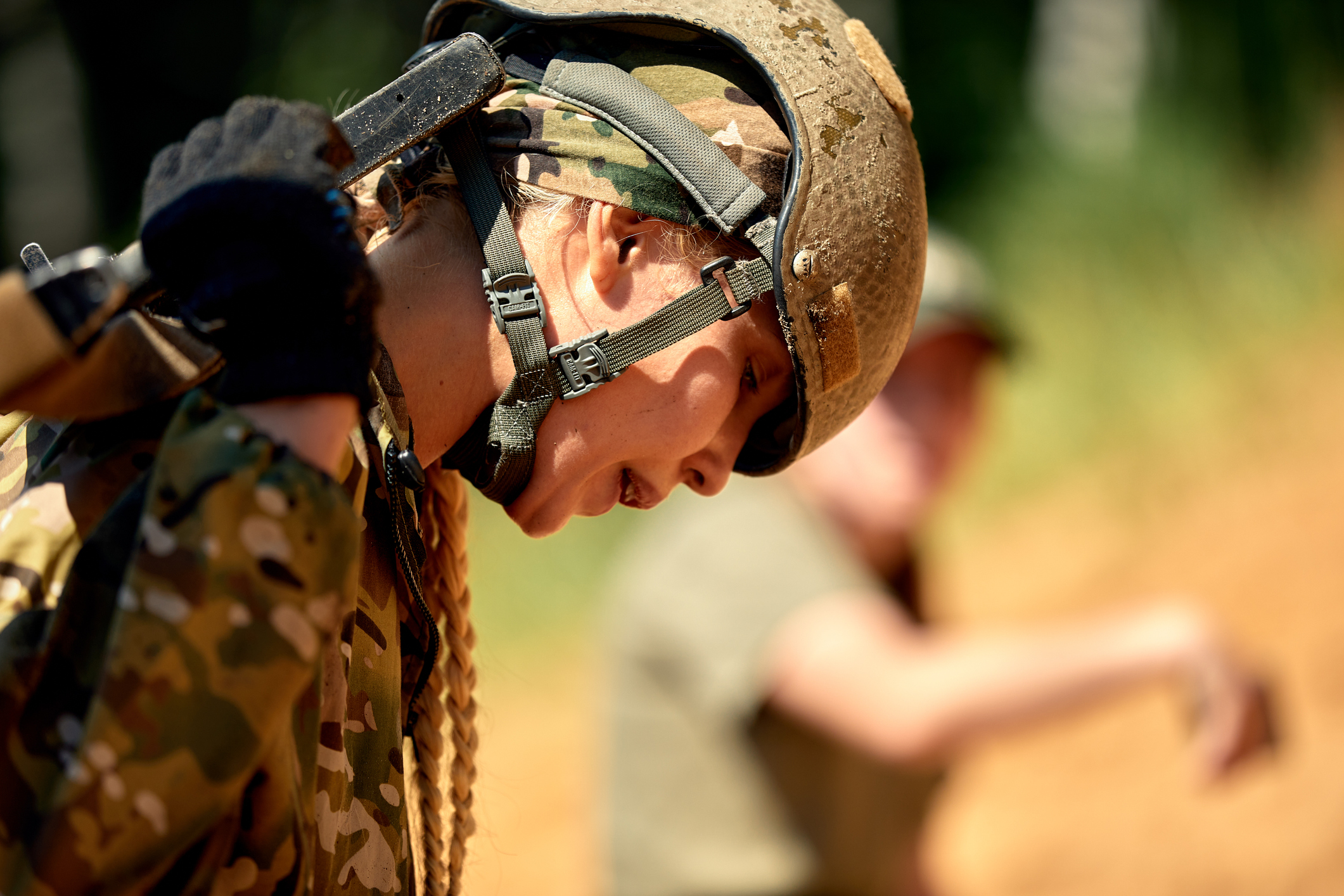
Fictional composite clinical scenario. The case and laboratory values are designed for professional education and do not describe a real veteran. Review the information at each decision point, select an answer in your mind, then open the explanation before continuing. No login or progress tracking is required.
CASE PRESENTATION
Persistent pneumonia-like illness after field training
Elena recently completed several weeks of field training in inland Southern California. Training involved digging, convoy operations, and prolonged exposure to windblown dust. Three weeks later, after returning to her base in the Midwest, she develops fever, cough, pleuritic chest pain, marked fatigue, headache, and night sweats. A chest radiograph shows a focal infiltrate. She receives antibiotics for community-acquired pneumonia but remains symptomatic.
Laboratory and diagnostic data
| Test | Result | Interpretation |
|---|---|---|
| WBC | 10.9 × 10⁹/L | Mild leukocytosis; nonspecific |
| Absolute eosinophils | 0.7 × 10⁹/L | Eosinophilia may occur but is not diagnostic |
| CRP | 78 mg/L | Inflammatory marker; nonspecific |
Fictional, clinically plausible educational values; use local reference ranges and assay cutoffs in practice.
CLINICAL DECISION 1 OF 3
Which history is most important in reframing this illness?
Reveal answer and clinical rationale
B. The combination of recent exposure to disturbed soil or dust and time spent in a Coccidioides-endemic region is the history that most directly changes the differential diagnosis. Coccidioides arthroconidia become airborne when contaminated soil is disrupted and are acquired by inhalation. Field exercises, digging, convoy activity, and other dusty training conditions can create substantial exposure. Symptoms often begin after the exposure has ended, so the patient may present after returning to a non-endemic area.
Why the other options do not fit
Branch of service does not determine risk; the relevant issue is where and how exposure occurred. Prior ability to complete physical training does not explain the current pulmonary syndrome. Current residence outside the Southwest does not erase a recent exposure—clinicians must ask where the patient has *been*, not only where the patient lives now.
References: 3, 4, 5.
CASE CONTINUED
Her clinician adds coccidioidomycosis to the differential and orders serologic testing. Coccidioides enzyme immunoassay (EIA) is positive for both IgM and IgG. Complement fixation (CF) is positive at a titer of 1:4. In the setting of her compatible pulmonary illness and recent dusty exposure in an endemic region, this serologic pattern supports recent coccidioidomycosis. The CF titer provides a useful baseline for follow-up but should not be used by itself to determine disease severity or exclude dissemination. Elena is clinically stable without hypoxemia.
CLINICAL DECISION 2 OF 3
Which statement about the diagnostic approach is most accurate?
Reveal answer and clinical rationale
C. Serology is an important component of the evaluation for coccidioidomycosis, but results must be interpreted in relation to timing, clinical presentation, and host factors. Antibody responses may not yet be detectable early in illness, and immunocompromised patients may have less robust serologic responses. When clinical suspicion remains high despite an initial negative or equivocal result, repeat serology and/or complementary diagnostic approaches—such as culture, histopathology, or other testing appropriate to the site of disease—may be warranted.
Why the other options do not fit
A single negative early serology does not always exclude infection. Geographic exposure remains relevant after the patient leaves an endemic region because infection was acquired at the time of exposure. Fungal culture can be diagnostically useful in selected patients, although access to Coccidioides cultures can be limited because of the biosafety requirements.
References: 3, 4.
CASE CONTINUED
One week later, after initiation of fluconazole oral therapy, Elena reports escalating headache, photophobia, nausea, and neck stiffness.
CLINICAL DECISION 3 OF 3
What is the most important next step?
Reveal answer and clinical rationale
B. Escalating headache, photophobia, nausea, and neck stiffness in a patient with suspected or established coccidioidomycosis should prompt urgent evaluation for central nervous system dissemination. Coccidioidal meningitis is a serious complication in which delayed diagnosis can lead to neurologic morbidity. Evaluation includes a careful neurologic assessment and, when clinically appropriate, lumbar puncture with cerebrospinal fluid cell count, glucose, protein, and Coccidioides-directed testing. Related findings, such as lymphocytic pleocytosis, low CSF glucose, elevated protein, and positive CSF antibody would support the diagnosis in the appropriate clinical setting.
Why the other options do not fit
Progressive neurologic symptoms should not be attributed to uncomplicated pneumonia. Changing antibacterial therapy does not address the possibility of fungal CNS dissemination. Waiting months for repeat chest imaging delays evaluation of a potentially life-threatening extrapulmonary complication.
References: 3, 5.
Beyond the infection
The key diagnostic clue was not visible on the chest image—it was in Elena’s training history. A veteran may present hundreds or thousands of miles from the place where an endemic fungal infection was acquired. Providers should be diligent in monitoring for indications of disseminated disease.
References
- Galgiani JN, Ampel NM, Blair JE, et al. 2016 Infectious Diseases Society of America (IDSA) clinical practice guideline for the treatment of coccidioidomycosis. Clin Infect Dis. 2016;63(6):e112-e146. doi:10.1093/cid/ciw360
- Centers for Disease Control and Prevention. Testing algorithm for coccidioidomycosis. Updated May 10, 2024. Accessed October 8, 2026. https://www.cdc.gov/valley-fever/hcp/testing-algorithm/index.html
- Crum NF, Lederman ER, Hale BR, Lim ML, Wallace MR. A cluster of disseminated coccidioidomycosis cases at a U.S. military hospital. Mil Med. 2003;168(6):460-464. doi:10.1093/milmed/168.6.460